
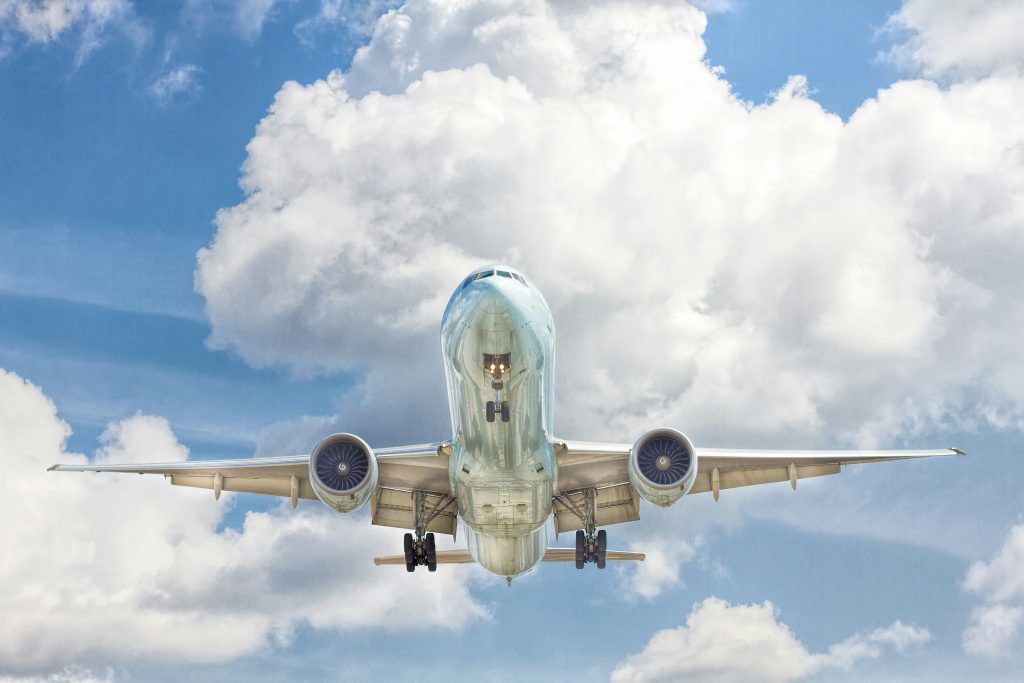
Air travel accounts for about 4% of the average Canadian’s individual carbon footprint [1], but this percentage varies greatly from person to person. Only 11% of the world’s population flies, and it is primarily the wealthiest individuals who travel by air frequently [2].
If we look at the carbon footprint of a flight between Montreal and Paris, we find an average value of about one ton of CO2 equivalent per person for a one-way trip. However, online carbon footprint calculators display highly variable results: from 300 kg to 5 tons for the same route. These variations in results depend on flight configurations, the type of trip, the aircraft, and the destination, of course, but also on the calculation method.
How is a passenger’s carbon footprint calculated for a flight?
To calculate a carbon footprint, one must account for the greenhouse gas (GHG) emissions generated at each stage of a flight’s life cycle. This includes the manufacturing of the aircraft and its components, the production and combustion of fuel, as well as airport infrastructure. On average, 80% of GHGs are emitted during fuel combustion (flight phase), 17% are linked to fuel production, and 3% to the construction of airports and aircraft [1], [2].
Fuel combustion is therefore the largest source of impact. To assess this impact, it is necessary to estimate fuel consumption during a flight, which will then allow for the calculation of the associated emissions from its combustion. Fuel consumption depends primarily on several factors:
- The distance traveled: the longer the journey, the more fuel is consumed.
- The total weight carried, which consists of the aircraft’s empty weight (50%), fuel (30%), passengers, their luggage, and any cargo. The total weight will therefore vary depending on the aircraft model as well as the number of passengers actually on board. The heavier the load, the more fuel is consumed.
- The number of stopovers: since takeoff and landing phases consume a lot of energy, a flight with a stopover will consume more fuel than a direct flight.
- Weather conditions, including wind direction and speed.
Are GHG emissions the only factor contributing to the climate impact of air travel?
The aviation sector accounts for approximately 2.4% of global greenhouse gas emissions, yet it contributes to about 4% of the overall impact on climate change [3].
GHG emissions are not the only cause of an airplane’s impact on the climate. Non-CO2 effects, primarily caused by contrails generated by airplanes, account for about half of a flight’s climate impact [4].
As it climbs, the aircraft will pass through the upper troposphere at an altitude of 8 to 13 km. There, particles from fuel combustion allow the emitted water vapor to condense and then freeze, forming cirrus-type clouds. These contrails have a net warming effect on the climate by trapping some of the infrared radiation emitted by the Earth, thereby increasing the greenhouse effect. A cooling effect occurs during the day because the contrails reflect some of the solar radiation, but it is less than the warming effect, resulting in a net warming effect.
To accurately quantify the carbon footprint, these non-CO₂ effects must therefore be taken into account. However, modeling them remains uncertain: depending on the indicators used, they can increase the carbon footprint by a factor of between 1.7 and 4 [5].
So what does this mean for a passenger?
Once the total carbon footprint of a flight is known, it can be allocated among the passengers to calculate an individual footprint. This allocation of impacts occurs in several steps [6].
First, a distinction is made between cargo and passengers with their luggage based on their mass. The more cargo the aircraft carries, other than luggage, the more impact will be allocated to cargo transport, and the less to passenger transport.
Next, the flight’s impact attributed to passengers is divided by the number of passengers to obtain the impact per passenger. The fuller the plane, the lower the impact per passenger. Since 2024, the load factor for Canadian carriers has been 84% [7].
Finally, the footprint per passenger is adjusted to account for the passenger’s class of travel. Since a first-class seat takes up about five times as much space as an economy-class seat, the carbon footprint of a first-class passenger will be five times higher than that of an economy-class passenger.
Ultimately, when non-CO2 effects are taken into account, a Montreal-Halifax flight in economy class is roughly equivalent in terms of climate impact to two people driving there by car.
Can we trust online calculators?
Online calculators provide an initial estimate of climate impact, helping us understand the environmental impact of travelling and encouraging those who are curious to delve deeper into the subject.
However, to assess their reliability, it’s important to review their methodology: the accuracy of the data used, whether non-CO₂ effects are accounted for, and the degree of customization in the calculation. A perfectly accurate representation of reality would require access to comprehensive, real-time data for every flight, which remains impossible today.
Probably one of the best online calculators to date is the one built into Google Flights, which displays the carbon footprint per passenger for each flight offered [8]. This calculator uses route-specific data to assess the aircraft’s fuel consumption. It refines the distance between airports by accounting for the Earth’s curvature and detours. It also takes into account the specific characteristics of the aircraft model used on each flight. It further uses the average load factor over the past six years for the route in question (when data is available) to determine the share attributed to each passenger, making the result highly representative. However, this calculator does not take into account the effect of contrails (though it explicitly states that this could have a significant impact), nor does it account for actual flight conditions such as the aircraft’s speed or weather conditions.
Is there a real benefit for the climate in choosing not to fly as an individual?
In the short term, the absence of a passenger on a long-haul flight that was already scheduled reduces the flight’s carbon footprint only very slightly: the plane takes off anyway, and the weight of one person and their luggage is negligible compared to the plane’s total mass. The savings in fuel—and thus in environmental impact—are very limited.
But in the long term, if many people stop flying, flights will become less profitable, leading to cancellations or reduced flight frequencies. With a collective effort, the reduction in the carbon footprint can become significant. As a reminder, the drastic reduction in air traffic during the 2020 pandemic led to a 50% decrease in GHG emissions from the aviation sector compared to 2019 [9]
How can you reduce the environmental impact of air travel?
For passengers, the first step is to limit the number of flights, for example by combining business and personal travel. Traveling to closer destinations and thus reducing flight time is also an option. In any case, it is wiser to choose direct flights whenever possible and to travel in economy class with limited baggage, in order to reduce the aircraft’s total weight.
On the airline side, many companies are working to optimize aircraft load factors, routes, and operations, which benefits both the environment and cost reduction. Replacing fleets with lighter, more fuel-efficient aircraft can also help reduce fuel consumption and, consequently, associated GHG emissions. Finally, airlines could use sustainable aviation fuels, which could reduce a flight’s GHG emissions by more than 90% [1]. These fuels, still in the development phase, could also significantly reduce particulate emissions and, consequently, contrails (due to a lower content of aromatic compounds) [10].
This blog post is from a column presented on September 10, 2025 (french version) by Laure Patouillard, Adjunct Professor and Research Associate at CIRAIG, in the program Moteur de recherche (Radio-Canada) hosted by Matthieu Dugal.
References
[1] M. Prussi et al., « CORSIA: The first internationally adopted approach to calculate life-cycle GHG emissions for aviation fuels », Renewable and Sustainable Energy Reviews, vol. 150, no June, 2021, doi: 10.1016/j.rser.2021.111398.
[2] B. Cox, W. Jemiolo, et C. Mutel, « Life cycle assessment of air transportation and the Swiss commercial air transport fleet », Transportation Research Part D: Transport and Environment, vol. 58, no November 2017, p. 1‑13, 2018, doi: 10.1016/j.trd.2017.10.017.
[3] M. Klöwer, M. R. Allen, D. S. Lee, S. R. Proud, L. Gallagher, et A. Skowron, « Quantifying aviation’s contribution to global warming », Environmental Research Letters, vol. 16, no 10, 2021, doi: 10.1088/1748-9326/ac286e.
[4] B. Kärcher, « Formation and radiative forcing of contrail cirrus », Nature Communications, vol. 9, no 1, p. 1‑17, 2018, doi: 10.1038/s41467-018-04068-0.
[5] D. S. Lee et al., « The contribution of global aviation to anthropogenic climate forcing for 2000 to 2018 », Atmospheric Environment, vol. 244, no July 2020, 2021, doi: 10.1016/j.atmosenv.2020.117834.
[6] IATA, « Recommended Practices-RP 1726:Passenger CO2 Calculation Methodology », p. 19, 2020.
[7] Statistiques Canada, « Passenger load factor, Canadian air carriers, Level I ». [En ligne]. Disponible sur: https://www150.statcan.gc.ca/n1/daily-quotidien/250528/cg-e001-eng.htm
[8] Google, « Travel Impact Model Estimating the Impact of Air Travel ». [En ligne]. Disponible sur: https://travelimpactmodel.org/
[9] International Energy Agency (IEA), « Tracking Aviation 2023 », 2023.
[10] R. S. Märkl et al., « Powering aircraft with 100% sustainable aviation fuel reduces ice crystals in contrails », Atmospheric Chemistry and Physics, vol. 24, no 6, p. 3813‑3837, 2024, doi: 10.5194/acp-24-3813-2024.