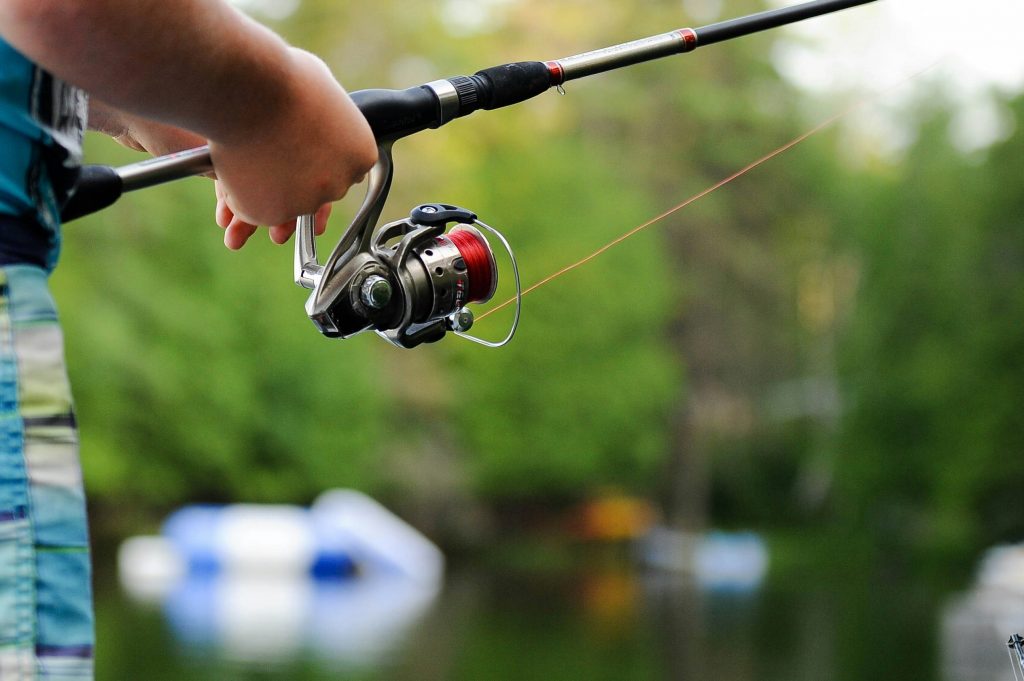
Although the majority of consumed fish comes from commercial fishing, recreational fishing is a popular outdoor activity in Canada, bringing together more than 3 million anglers [1].
A few fishing lines and lead sinkers at the bottom of the water, is it really that big of a deal?
This question mainly concerns gear lost during recreational fishing, such as nylon lines, hooks, synthetic bait, and lead weights. In commercial fishing, however, we are talking about multi-kilometer nets, traps, and longlines with thousands of hooks.
In scientific literature, there is little information on the environmental impact of recreational fishing [2], but its challenges resemble, on a smaller scale, those of commercial ocean fishing, which is better documented.
Lost gear has several direct impacts on biodiversity. Lost, abandoned, or discarded fishing gear can continue to trap marine species, injuring or killing them, a phenomenon known as ghost fishing [3]. Beyond physical damage, another direct impact of these losses is plastic pollution. Indeed, fishing is a major source of plastic pollution, accounting for 0.6 Mt/year [4]. This quantity is divided between macroplastics and microplastics. Macroplastics are large debris from lines or nets in which marine animals become entangled. Their degradation is slow and uncertain, so their impact can last for a long time [5]. Microplastics, which result from plastic breakdown, are ingested by fish, potentially causing suffocation and disrupting marine ecosystems. This latter point is not yet extensively documented and is currently being researched by the MarilCa group, which includes members from CIRAIG. Finally, lead weights are sometimes used and lost in the water, where they dissolve, causing an additional toxic effect on ecosystems [6].
Is line fishing’s impact comparable to other fishing technics?
Beyond the impacts related to lost gear, some fishing techniques are worse for biodiversity than others [3].
The worst fishing technique for biodiversity is bottom trawling, which accounts for a quarter of global catches [7]. These are massive nets dragged along the seafloor to catch species such as cod, sole, or shrimp. Dredges operate on the same principle but use iron cages to catch mollusks, generating the same type of impact. While these techniques are effective in terms of catch volume [8], they destroy the seabed and, consequently, the organisms and habitats of the species living there. In fact, penetrating just two centimeters into the sediment kills about 6% of benthic organisms [9]. At sixteen centimeters, 40% are killed, and coral reefs that took centuries to form can be destroyed in a single pass. Furthermore, because bottom trawl nets lack selectivity, 25% to 50% of the catch is bycatch [9], species not targeted, such as juveniles, marine mammals, turtles, etc. Around 10% of fish caught worldwide are thrown back into the sea dead or injured [9].
At the other end of the spectrum, the best techniques are those that cause no habitat destruction and almost no bycatch [8]. These include line fishing, the most popular method in recreational fishing, and trap/pot fishing. Pots are cages placed on the seabed to catch crab or lobster that allow undersized species to escape. Their only drawback is ghost fishing if they are abandoned.
In between lies a whole spectrum of fishing techniques. Gillnets catch many non-target species, including sharks and marine mammals. Longlines (lines with thousands of hooks) can reduce their bycatch if set deeper and fitted with circle hooks. Purse seines, which encircle schools of fish, generate significant bycatch—especially juveniles—though much less if fish aggregating devices (FADs) are avoided.
The general rule to remember is the more selective and static the technique, the less destructive it is.
Could we empty the ocean of all its fish through fishing?
Indeed, another major biodiversity issue associated with fishing that cannot be ignored is overfishing. When fish are harvested faster than they can reproduce, stocks collapse and populations shrink. A sad example in Canada is the Northern Atlantic cod: the stock collapsed within a few decades and has never truly recovered [10].
Today, 1 out of every 5 fish caught globally comes from overfished stocks [9]. Preventing this requires sustainable fisheries management. On Canada’s East Coast, only 25% of marine populations are confirmed to be sustainably harvested, with the status of 45% of fish stocks in Canada remaining unknown [11].
Tuna, sharks, rays, and mackerel are overfished species [9]. However, overfishing risk depends not only on the species, but also on origin and sub-species: bluefin tuna is highly threatened, particularly in the Indian Ocean, whereas yellowfin, Atlantic, or Pacific tuna fare better [9]. Overfishing does not just threaten target species; it unbalances the entire food web. Removing too much tuna disrupts both the prey species they feed on (which then face fewer predators and proliferate) and the predators that feed on them.
Does fishing also impact climate change?
The carbon footprint of fishing is less frequently discussed, yet it is significant. The main culprit is boat fuel [3], as well as fuel for personal vehicles traveling to fishing sites in the case of recreational fishing. The farther you travel to fish, the higher the fuel consumption.
Certain fishing techniques are extremely energy-intensive, such as bottom trawling and dredging, making the carbon footprint of flatfish like sole particularly high. Depending on the species and technique, the carbon footprint of seafood ranges from 2 to 24 kg of CO₂ per kg [3]. For context, wild-caught lobster approaches the footprint of beef. Indeed, its catch yield is very low: one or two lobsters per trap for hours of boating. Conversely, small pelagic fish, like herring, sardines, or anchovies have a very low footprint: they form dense schools near coasts, allowing large harvests with minimal fuel. However, variability can be significant even within a single species. Wild-caught salmon can range from 2 to 17 kg CO₂eq depending on where it originates and how it was caught. Origin and fishing technique matter just as much as species.
How can we determine the best choices for the environment?
That is where things get complicated! A species with a high carbon footprint, like lobster, might be harvested using methods that are gentler on biodiversity, such as traps. Conversely, a species like tuna might have a reasonable carbon footprint while being endangered due to overfishing.
Although carbon footprint, overfishing, bycatch, seabed destruction, plastic pollution, and ghost fishing all impact biodiversity, science cannot yet weigh them on a single scale to determine their relative importance. Research is currently underway [5], but in the meantime, making environmentally conscious choices requires navigating tradeoffs among these issues.
Is aquaculture better?
In aquaculture, overfishing and bycatch are non-issues. However, other environmental impacts must be considered, including the carbon footprint of feed production, freshwater consumption, and coastal water eutrophication risks. In certain contexts, aquaculture can also contribute to mangrove destruction—particularly for shrimp farming—and pose risks of genetic contamination if farmed species escape and interbreed with native populations [3].
On average, farmed salmon and mussels have a lower carbon footprint than their wild-caught counterparts [3], with no overfishing risk. Aquaculture is therefore often a safer choice when the origin and fishing method are unknown.
What can we do to reduce environmental impact at our scale?
For recreational fishing, a few simple habits can help lower your environmental footprint: fish close to home, avoid using motorized boats, invest in durable gear to prevent breakage, and select lead-free weights.
For fish buyers, a few key questions can guide decision-making: Where does it come from? How was it caught? Is it certified? The MSC (Marine Stewardship Council) label serves as a reliable guide against overfishing. Finally, diversifying consumed species helps relieve pressure on a few heavily targeted options.
This blog post is based on a segment presented on June 17, 2026 (french version) by Laure Patouillard, an associate professor and research fellow at CIRAIG, on the program Moteur de recherche (Radio-Canada), hosted by Matthieu Dugal.
References
[1] Pêches et Océans Canada, “2021 Info-éclair Pêches canadiennes.” 2021.
[2] A. R. Watson et al., “Source, fate and management of recreational fishing marine debris,” Mar. Pollut. Bull., vol. 178, no. April, p. 113500, 2022.
[3] J. A. Gephart et al., “Environmental performance of blue foods,” Nature, vol. 597, no. 7876, pp. 360–365, 2021.
[4] J. Boucher, G. Billard, E. Simeone, and J. Sousa, The marine plastic footprint : towards a science-based metric for measuring marine plastic leakage and increasing the materiality and circularity of plastic. 2020.
[5] C. Askham et al., “Expanding life cycle impact assessment to account for marine plastic emissions: a case study for the fishing industry,” Int. J. Life Cycle Assess., vol. 31, no. 1–3, p. 46, Mar. 2026.
[6] W. C. Lewin et al., “Potential Environmental Impacts of Recreational Fishing on Marine Fish Stocks and Ecosystems,” Rev. Fish. Sci. Aquac., vol. 27, no. 3, pp. 287–330, 2019.
[7] T. Cashion et al., “Reconstructing global marine fishing gear use: Catches and landed values by gear type and sector,” Fish. Res., vol. 206, no. April, pp. 57–64, 2018.
[8] Monterey Bay Aquarium, “Fishing & farming methods.” [Online]. Available: https://www.montereybayaquarium.org/animals-the-ocean/how-to-choose-sustainable-seafood/fishing-and-farming-seafood/fishing-and-farming-methods. [Accessed: 12-Jun-2026].
[9] H. Ritchie and M. Roser, “Fish and Overfishing – Our World in Data,” Our World in Data, 2021. [Online]. Available: https://ourworldindata.org/fish-and-overfishing.
[10] R. Schijns, R. Froese, J. A. Hutchings, and D. Pauly, “Five centuries of cod catches in Eastern Canada,” ICES J. Mar. Sci., vol. 78, no. 8, pp. 2675–2683, 2021.
[11] Oceana, “Here’s the catch: HOW TO RESTORE ABUNDANCE TO CANADA’S OCEANS.” 2016.
[12] M. Ottinger, K. Clauss, and C. Kuenzer, “Aquaculture: Relevance, distribution, impacts and spatial assessments – A review,” Ocean Coast. Manag., vol. 119, no. 2016, pp. 244–266, 2016.